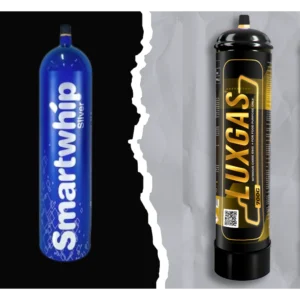
As a restaurant owner, bakery chef, or high-volume beverage manager, you already know that margins in the hospitality industry are razor-thin. Every single line item on your inventory sheet matters—especially recurring consumables.
If your kitchen staff is still cracking open those tiny, individual 8g steel cream charger bulbs to prepare whipped cream, mousses, or rapid cocktail infusions, you are leaking cash.
The immediate alternative is switching to large-format nitrous oxide ($N_2O$) cylinders. But is making the switch economically viable for your business? This ultimate financial breakdown focuses explicitly on the Smartwhip price per gram versus traditional 8g bulbs, showing you why a bulk shift is the smartest financial decision you can make for your commercial kitchen.
The Raw Math: Price Per Gram Breakdown
To truly understand how the Smartwhip price compares to traditional chargers, we have to look past the retail sticker cost and calculate the cost per gram of usable $N_2O$ gas.
A standard individual cream charger bulb contains exactly 8 grams of culinary gas. A baseline master case of traditional chargers usually holds 600 pieces, giving you a total of 4,800 grams of gas. Depending on your local restaurant supply vendor, this case can run anywhere from $240 to $300. That brings your average cost to roughly $0.050 to $0.062 per gram.
Now, let’s look at the wholesale large-format alternative. A single standard Smartwhip cylinder contains 580 grams to 640 grams of pure, food-grade $N_2O$ (equivalent to roughly 70 to 80 individual 8g bulbs). When buying in bulk or pallet quantities, the financial leverage dramatically shifts.
When you buy a bulk master carton or invest in wholesale multi-packs, the Smartwhip price per tank drops significantly. On a bulk tier scale, your cost per gram plummets to $0.025 to $0.035 per gram.
The Immediate Financial Takeaway: By analyzing the pure gas cost, the bulk Smartwhip price cuts your literal ingredient expenditure nearly in half compared to buying box after box of loose 8g bulbs.
Head-to-Head Comparison: Bulk Smartwhip vs. 8g Bulbs
| Cost & Efficiency Metric | Traditional 8g Bulbs (Case of 600) | Smartwhip Large Format (Bulk Wholesale) |
| Total Gas Weight | 4,800 grams | Varying scalable volumes (Bulk custom) |
| Average Cost Per Gram | $0.050 – $0.062 | $0.025 – $0.035 (Massive Savings) |
| Refill Downtime | 30 to 45 seconds per bulb swap | Continuous stream with regulator |
| Product Loss (Gas Waste) | 10% to 15% via leaking/duds | Close to 0% via sealed hose connection |
| Disposal & Recycling Costs | High metal waste footprint | 100% recyclable single cylinder |
The Hidden Costs of 8g Bulbs (Where You Lose Money)
The financial comparison involves more than just the baseline price per gram. Traditional 8g bulbs carry heavy operational liabilities that drain restaurant profits completely behind the scenes.
1. The Labor Cost of “The Twist”
Watch your line cooks during peak Saturday night service. Every time a whipping siphon runs empty, a cook must stop, unscrew the plastic shroud, remove the spent 8g shell, drop in a new bulb, twist it until it pierces, shake the siphon, and discard the metal waste.
This process takes roughly 45 seconds. If your bakery or busy bar goes through 40 siphons a night, your staff spends over half an hour of pure, paid labor time just twisting metal bulbs. Because a Smartwhip tank connects directly via a pressure regulator and filling hose, refilling a siphon takes under 5 seconds. Switching to a bulk system recovers those hours of lost labor capacity immediately.
2. Gas Wastage and Hollow “Duds”
Anyone who has managed a commercial kitchen kitchen knows that cheap 8g bulb boxes are filled with structural variance. You consistently find “duds”—bulbs that are completely empty or lose their seal and spray gas everywhere before fully charging the siphon. Chefs routinely over-compensate by cracking two or even three bulbs into a single siphon just to ensure structural firmness, which instantly doubles your material cost per serving.
The custom pressure regulator paired with the Smartwhip price setup completely eliminates gas waste. The gas feeds continuously through an airtight matrix until the chamber hits your exact designated bar pressure. You get a perfect, un-split cream structure every single time with zero gas escaping into thin air.
3. Steel Disposal Footprint
Discarding thousands of tiny steel shells creates logistical waste headaches. Many modern municipal commercial recycling programs charge businesses based on heavy metal weight pickup or refuse them outright if they are mixed into standard garbage. A single large-format Smartwhip cylinder replaces up to 85 individual bulbs, shrinking your kitchen’s physical waste footprint down to a clean, easily recyclable empty tank.
Maximize Profit Margins: Why Buying Smartwhip in Bulk Wins
If you purchase cream chargers on a week-to-week, single-tank basis, you are paying standard retail markup. To truly unlock the financial benefits of the competitive Smartwhip price, you need to scale up your inventory purchasing parameters.
Buying Smartwhip in bulk pallet orders or multi-case tiers allows your kitchen to secure the lowest possible price tier per gram. Because nitrous oxide is completely shelf-stable and stored safely in pressurized steel, these tanks do not spoil or expire. Your upfront capital investment transforms directly into stable, long-term food cost reductions that pad your bottom line over the next 6 to 12 months.
If you are ready to stop throwing money away on outdated, labor-intensive 8g cartridges, look at our wholesale tier structures. We offer massive wholesale discounts on bulk Smartwhip orders designed specifically to help commercial bakeries, high-volume catering services, and premium bars cut operational costs.